Checking your banknotes is easy using two key security features on paper £20 and £50 banknotes
Are you a retailer or business who handles cash? Are you confident that you and your staff know how to check for genuine notes?
While counterfeiting remains very rare (less than 0.05% of notes in circulation are counterfeit) and members of the public are unlikely be affected, retailers and businesses are on the front line and carry the cost of any fake notes which they accept as payment. Counterfeit banknotes are only produced because criminals believe they will find somewhere to spend them and can do so without consequence, so along with our partners in Law Enforcement we’re encouraging retailers to take preventative action.
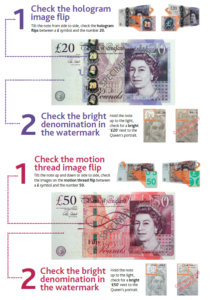
With the £20 and £50 our only remaining paper notes, we’ve highlighted the two key security features on these notes that you can use to check whether they are genuine.
We’ve produced free of charge training materials which include short videos on the £20 and the £50, and a downloadable guide which all focus on these two key features:
1. Image flip between the £ symbol and the denomination number in the hologram on the £20 and in the motion thread on the £50; and
2. Bright £20 or £50 denomination in the watermark, next to the Queen’s portrait.
With the support of National Pubwatch and other Strategic Partners, we have also launched our Banknote Checking Scheme to support retailers and businesses and promote banknote checking, preventing the financial and reputational losses associated with counterfeit notes. The Bank has already received pledges of support from over 120 businesses including J D Wetherspoon, Pret a Manger, Waterstones and WHSmith as well as many independently run pubs and bars, representing over 10,000 locations across the United Kingdom.
The national convenience store chain OneStop Plc are a supporter of the Scheme and said:
“Pledging our support to the Bank of England’s Banknote Checking Scheme has helped us to:
– Provide up-to-date and relevant training material for colleagues.
– Align and update our counterfeit banknote processes.
– Empower our colleagues to feel more confident in knowing what to do in the event they suspect they have received a counterfeit note.”
You can find out more information about how to check your banknotes and how to pledge your support for the Banknote Checking Scheme on the Bank of England’s website www.bankofengland.co.uk/banknotecheckingscheme .
Footnotes:
• A range of free educational materials can be found on the Bank’s website, along with instructions on how to download our interactive banknote app.
• The Scheme is a collaboration between the Bank of England and the Scheme’s strategic partners. These are the Association of Convenience Stores (ACS), British Retail Consortium (BRC), Crimestoppers, National Crime Agency (NCA), National Pubwatch, Petrol Retailers Association (PRA) and Retailers Against Crime, National Police Chief’s Council, National Business Crime Centre, National Pawnbrokers Association and the Charity Retail Association.
• The six guiding principles of the Scheme are:
Your staff:
1. Are trained and check banknotes at point of sale;
2. Know what to do with a counterfeit banknote;
Your business:
3. Shares information with the Bank of England;
4. Promotes the Scheme;
5. Supports law enforcement activities; and
6. Appoints a single point of contact for the Scheme.
• You can see a list of retailers who have already pledged their support to the Scheme on the Bank of England’s website.